
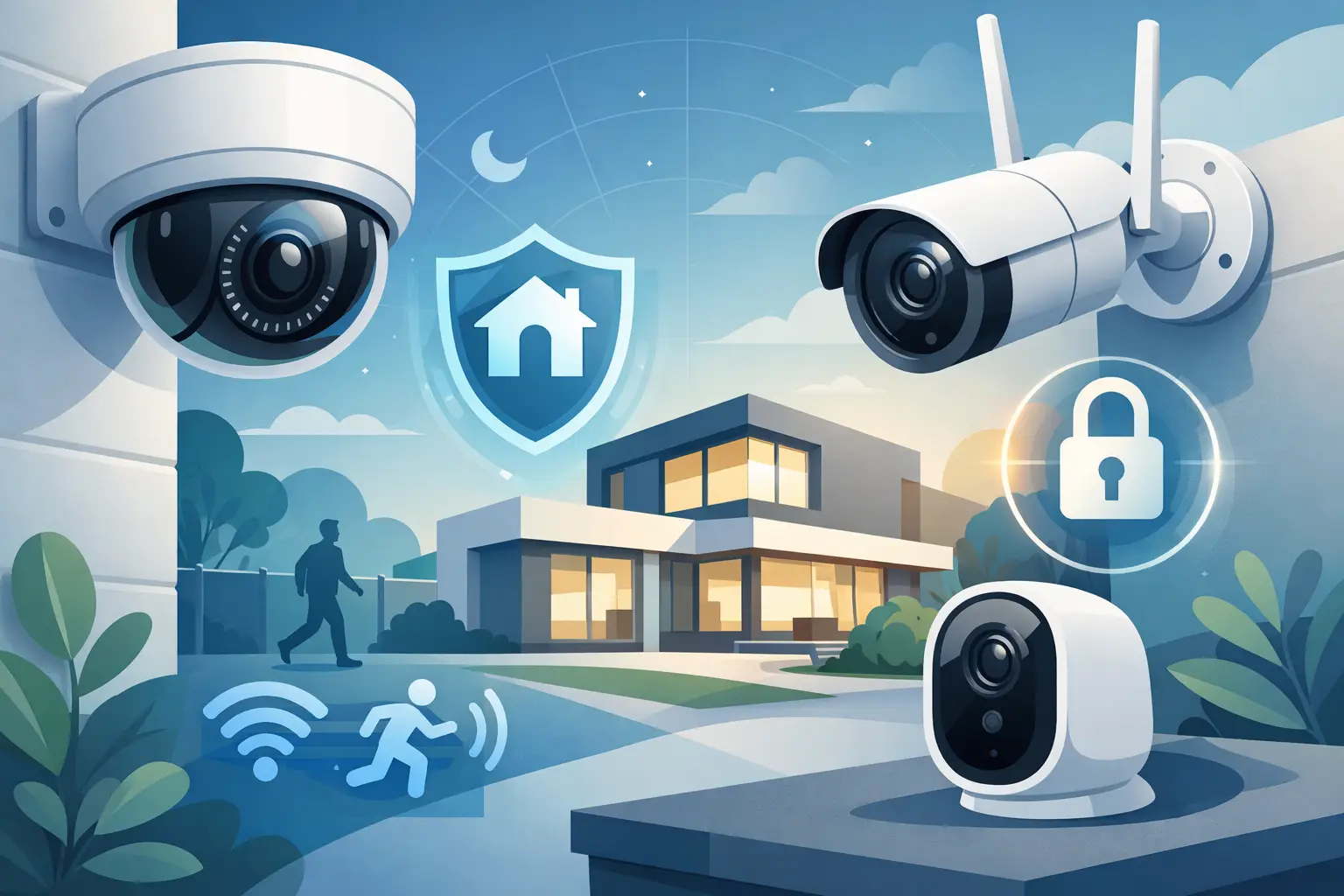

A camera that captures a clear face at your front door but turns headlights into a white blur at the driveway is not doing enough. The best outdoor security cameras are not simply the ones with the biggest resolution number. They are the cameras that provide usable evidence, cover the right areas, hold up through Northeast weather, and remain easy to access when something happens.
For homeowners, that may mean checking deliveries, watching a side gate, or receiving an alert when someone approaches after dark. For businesses, schools, and public facilities, it can mean monitoring entrances, parking lots, loading areas, employee access points, and perimeter gates. The right answer depends on the property, the risk, and how the system will be used every day.
What Makes an Outdoor Camera Worth Installing?
Outdoor cameras work in difficult conditions. Rain, snow, summer heat, wind, low light, reflections, and shifting shadows can all affect the image. A dependable system starts with equipment rated for the environment, but it also requires thoughtful placement, correct wiring, network capacity, and recording that is ready when it is needed.
A camera should answer a practical question: can you identify what happened? A wide view is useful for seeing activity across a yard or parking lot, but a wide-angle camera mounted too high may not provide enough detail to identify a person or read a license plate. The most effective systems balance overview coverage with closer, targeted views.
For this reason, the best camera is often not one camera. A front entrance may need a fixed camera aimed at faces, while a driveway benefits from a second camera with a tighter field of view. A business may need separate coverage for the public entrance, rear delivery door, cash-handling area, parking lot, and gate. Proper design prevents the common problem of having video of an incident without a useful image of the person responsible.
Best Outdoor Security Cameras by Property Need
Rather than choosing from a list based on brand names alone, start with the camera type that fits the location.
Fixed turret or dome cameras for entrances
Fixed cameras are a strong choice for front doors, side doors, walkways, and building entrances. They remain pointed at a defined area and can be selected with the correct lens angle for that location. Turret-style cameras are especially practical outdoors because they are easier to aim precisely and are less likely to suffer from infrared glare caused by a dirty or scratched dome cover.
For a home, a fixed camera covering the front approach can capture visitors before they reach the door. For a commercial property, cameras at each entrance help document access, deliveries, and after-hours activity. Positioning matters. The camera should be high enough to discourage tampering but low enough to capture faces instead of hats and the tops of heads.
Bullet cameras for driveways and perimeter coverage
Bullet cameras are commonly used for driveways, rear yards, fences, parking areas, and building perimeters. Their visible shape can act as a deterrent, and their adjustable mounting makes them useful when the camera must look down a driveway, along a fence line, or toward a distant gate.
A longer focal length can provide a narrower, more detailed view of a vehicle entrance or a specific section of a lot. That is useful when identification is more important than seeing the entire area at once. The trade-off is reduced side-to-side coverage, which is why a site survey should come before choosing a lens.
Pan-tilt-zoom cameras for active, large-area monitoring
Pan-tilt-zoom, or PTZ, cameras can move, zoom, and follow preset views. They are valuable for larger commercial properties, campuses, yards, and parking lots where an operator may need to investigate live activity. They can also cycle through preset positions to watch multiple areas.
A PTZ should not be the only camera protecting a critical point of entry. When it is looking in one direction, it is not recording detailed coverage elsewhere. Fixed cameras provide continuous evidence at key doors and access points, while a PTZ adds flexibility for large-area observation.
Doorbell and compact cameras for residential awareness
Doorbell cameras and compact wireless cameras can be useful for homeowners who want alerts and a quick view of the front porch, side yard, or detached garage. They are convenient, but convenience should not be confused with complete coverage. Battery-powered cameras may record only when motion is detected, and Wi-Fi performance can change with distance, walls, interference, or a weak router.
These cameras can be part of a good residential plan, particularly for a single entry point. For continuous coverage, larger properties, or areas where reliable evidence matters, a professionally installed wired camera system is usually the stronger long-term option.
Features That Matter More Than Marketing Claims
Resolution is important, but it is only one part of image quality. A high-resolution camera with poor lighting, a bad angle, or insufficient storage can still fail when it matters. When comparing outdoor camera systems, focus on these four practical factors:
- Night performance: Infrared night vision works well in complete darkness, but nearby walls, soffits, and reflective surfaces can create glare. Color night vision can improve detail where there is enough exterior lighting. In some locations, adding a properly aimed light produces better results than relying on infrared alone.
- Weather rating and installation quality: Look for equipment designed for outdoor exposure, but remember that cable entry points, junction boxes, mounting surfaces, and surge protection matter too. Water intrusion often comes from an installation issue, not the camera housing itself.
- Power and connectivity: Power over Ethernet, or PoE, delivers power and data over one network cable. It is reliable, supports continuous recording, and avoids frequent battery changes. Wi-Fi cameras can work well in the right location, but each device depends on stable wireless coverage.
- Recording and retention: Cloud recording may be convenient, while a local network video recorder offers greater control and can retain continuous footage without depending entirely on an internet connection. Storage should be sized for the number of cameras, resolution, recording schedule, and how long footage must be kept.
Smart motion alerts also deserve a closer look. Person, vehicle, and line-crossing detection can reduce unwanted notifications from trees, rain, animals, and traffic. The settings still need to be adjusted for the site. An alert system that sends dozens of false alarms a day quickly gets ignored.
Plan Coverage Before Buying Equipment
A useful camera plan begins at the points where people, vehicles, or property enter and leave. At a home, those locations often include the front door, driveway, rear door, garage, side gate, and any area where packages are left. At a business, priorities usually include customer entrances, employee doors, loading zones, cash or inventory areas, parking lots, and restricted-access doors.
Walk the property during the day and after dark. Notice where exterior lights create shadows, where trees or signs may block a view, and where a person could approach without being seen. Consider seasonal changes as well. A camera that has a clear view in winter may be blocked by foliage in July.
Avoid mounting every camera at the highest point of the building. High placement protects the equipment, but it often reduces identification detail. A better approach may use high cameras for overview coverage and lower, protected cameras for facial recognition at key approaches. This combination is especially effective at commercial entrances and gated properties.
Wired vs. Wireless: Choose Reliability for Critical Areas
Wireless cameras are attractive because they can be installed quickly. They are often appropriate for a limited residential need, temporary coverage, or a location where running cable is genuinely impractical. However, they depend on Wi-Fi range, wireless signal conditions, battery maintenance or nearby power, and sometimes a subscription for full recording features.
Wired IP cameras are typically the better choice for permanent protection. A PoE system provides stable power, predictable connectivity, central recording, and easier expansion when designed correctly. It also gives property owners more control over their footage. For businesses, schools, and facilities with multiple cameras, wired infrastructure is usually the practical foundation.
The network should be planned as part of the security system, not treated as an afterthought. Cameras consume bandwidth and storage, particularly when recording high-resolution video around the clock. Proper configuration helps protect the network while ensuring remote viewing remains responsive for authorized users.
Professional Installation Protects the Investment
A camera system can look complete on a phone screen and still have serious weaknesses: blind spots, poorly aimed lenses, exposed wiring, unstable Wi-Fi, inadequate storage, or no recorded footage during a network interruption. Professional installation addresses those details before they become a problem.
ATECH SECURITY LLC designs camera systems around the property rather than selling a one-size-fits-all package. That includes selecting appropriate camera locations, installing low-voltage cabling cleanly, configuring IP networking, setting up remote access, and providing service when equipment or site needs change. This approach is valuable for homeowners who want dependable coverage and for organizations that need a system their staff can rely on.
The best time to improve outdoor surveillance is before an incident creates an urgent need for footage. Start with the areas that matter most, choose equipment that fits the environment, and build a system that gives you a clear view when it counts.
Comments