
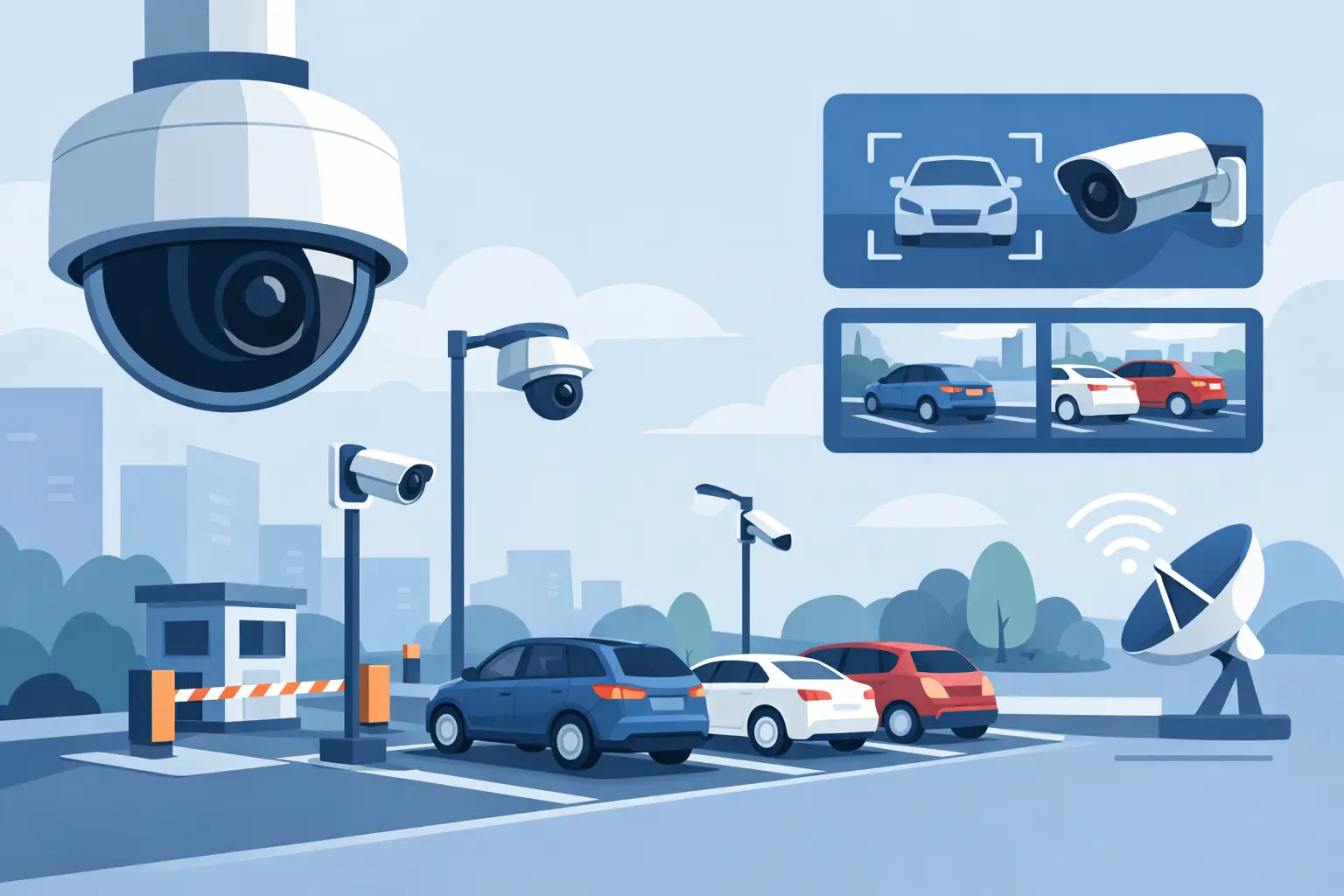

A parking lot camera that produces a dark, blurry image after an incident has already failed its most important job. The best cameras for parking lots are selected around real conditions: vehicle speed, lighting changes, entry points, distance, and the details a property owner may need to identify a person or vehicle.
For businesses, schools, apartment communities, medical offices, and public facilities, a parking lot is more than extra pavement. It is an active perimeter where theft, vandalism, vehicle damage, trespassing, and unsafe activity can occur outside normal business hours. A properly designed camera system gives staff a clearer view of what is happening and a dependable record when questions arise.
What the Best Cameras for Parking Lots Need to Do
Parking lot surveillance has different demands than an indoor hallway or front desk camera. The area is wide, conditions change quickly, and headlights can turn a usable image into glare. A good system must provide broad coverage without sacrificing the ability to recognize meaningful details.
Resolution matters, but it is not the whole answer. A high-resolution camera mounted too high or aimed at too wide an area may show that a vehicle was present without showing its plate or the driver’s face. Camera placement, lens choice, mounting height, and lighting all affect what can actually be identified.
For most commercial and institutional properties, IP cameras are the preferred choice. They can provide high-definition or ultra-high-definition video, remote viewing, motion alerts, and scalable recording. They also require sound network planning. A camera system should not compete with business operations for bandwidth or be exposed to unnecessary network risks.
Wide-Angle Coverage Cameras
Wide-angle fixed cameras are useful for covering open parking rows, walkways, building entrances, dumpsters, loading areas, and pedestrian paths. A 4K camera can provide excellent overview coverage when installed at the right height and aimed at a defined zone.
These cameras are a practical foundation for many lots because they document movement across a large area. The trade-off is detail at a distance. Wide-angle views should be paired with tighter cameras at key locations rather than being expected to identify every face or license plate across an entire lot.
Varifocal Cameras for Critical Zones
A varifocal camera allows the installer to adjust the lens angle to match the coverage area. This makes it a strong choice for drive lanes, gate approaches, building-side parking, and locations where a fixed lens would either miss part of the scene or capture too much empty space.
Varifocal cameras are especially valuable when a property needs a better balance between overview and detail. Instead of guessing at the correct lens during planning, the field of view can be dialed in during installation. That flexibility often makes the difference between useful evidence and a camera view that is simply too broad.
License Plate Capture Cameras
A standard surveillance camera is not always a license plate camera. Plates can be difficult to capture because of headlights, reflections, speed, angle, weather, and the large difference between bright and dark areas in a single frame.
Dedicated license plate capture cameras are designed for a narrow task: recording readable plates at a controlled entry or exit lane. They are typically aimed at a specific distance and vehicle path, with settings adjusted for the location. They work best when paired with overview cameras that show the vehicle, its direction of travel, and activity around it.
For a gated property, this combination is particularly effective. An overview camera documents the approach, while a plate-focused camera captures the identifying information. When integrated with a remote-capable gate system or access control, management has a much clearer record of who entered and when.
PTZ Cameras for Active Monitoring
Pan-tilt-zoom, or PTZ, cameras can move across a wide area and zoom in on activity. They are useful for larger facilities, active security posts, and properties where staff may need to follow an incident in real time.
A PTZ camera is not a replacement for fixed coverage. If it is turned toward one area, it cannot record detail in another direction at the same time. For that reason, PTZ cameras are best used as an added tool alongside fixed cameras that continuously cover entrances, drive lanes, and high-risk areas.
Nighttime Performance Is Not Optional
Many parking lot incidents happen after dark, when poor lighting can reduce the value of even an expensive camera. Infrared night vision helps cameras see in low-light conditions, but infrared alone does not solve every problem. It can cause reflections from signs, windshields, wet pavement, and nearby surfaces.
Cameras with strong low-light sensors and wide dynamic range are often a better fit for lots with uneven lighting. Wide dynamic range helps manage difficult scenes, such as a vehicle entering from a bright street into a darker lot or a person walking beneath a powerful exterior light.
Color night vision can be helpful where there is enough ambient or supplemental light. Color footage may provide better detail about vehicle color, clothing, or other identifying features. However, adding light must be planned carefully to avoid creating glare, disturbing neighbors, or producing new blind spots.
A site evaluation should consider existing pole lights, building-mounted fixtures, gate lighting, and areas that become completely dark after closing. In many cases, the best improvement is not a different camera alone but a better combination of camera placement and security lighting.
Plan Coverage Around Risk, Not Just Square Footage
It is tempting to count camera channels and divide them across the size of the lot. That approach often leaves important areas underprotected. A better plan starts with how people and vehicles move through the property.
The first priorities are usually entrances and exits, pedestrian routes, accessible spaces, building doors, loading zones, payment equipment, dumpster areas, and locations where vehicles are frequently damaged or broken into. Properties with gates should also cover the gate operator, call box, credential reader, and the lane on both sides of the gate.
Camera placement should account for obstructions that change by season. Trees grow, delivery trucks park, snow piles up, and temporary signage appears. Cameras mounted on a building may cover one section well but miss a row hidden behind parked SUVs or landscaping. Pole-mounted cameras can extend coverage, but they need proper power, network connectivity, weather protection, and surge protection.
Recording, Remote Access, and Retention Matter
A camera is only as useful as the footage that can be retrieved. Recording systems should be sized for the number of cameras, their resolution, activity level, and the number of days footage must be retained. Higher resolution and continuous recording require more storage, so retention should be discussed before equipment is selected.
Motion-based recording can conserve storage, but a poorly configured system may create excessive alerts from headlights, rain, shadows, or traffic outside the property. Smart analytics can help distinguish people and vehicles from general movement, reducing nuisance notifications and making searches faster.
Remote viewing gives property owners and managers the ability to check live video from a phone, tablet, or computer. It should be configured securely, with individual user access where appropriate and strong password practices. For businesses and schools, not every user needs the same permissions. Separating administrator, manager, and viewing-only access improves accountability.
Choose Equipment That Can Handle the Environment
Parking lot cameras live outside. They need housings rated for rain, dust, heat, cold, and changing weather. In the Northeast, that also means considering snow, ice, wind, and summer heat. A camera may be rated for outdoor use but still need a properly sealed connection, protected cable path, and stable mounting surface to perform reliably over time.
Vandal-resistant dome cameras can be a good choice near building entrances, lower mounting locations, and areas where equipment could be tampered with. Bullet-style cameras are often easier to aim over longer distances and can act as a visible deterrent. The right choice depends on the location, not appearance alone.
Do not overlook service access. Cameras installed where they cannot be safely adjusted, cleaned, or serviced can become a long-term problem. A professional installation should account for future maintenance from the start.
A Better Parking Lot System Is a Designed System
There is no single camera model that is best for every property. A small office lot may need two or three carefully aimed cameras, while a school, warehouse, apartment complex, or municipal site may need a layered system with wide views, plate capture, access control integration, and monitored gate points.
ATECH SECURITY LLC helps property owners build systems around the areas that matter most, with professional installation, network-aware setup, remote access, and ongoing service support. The goal is not to fill a parking lot with cameras. It is to make sure the footage is clear, available, and useful when your property needs it most.
Before choosing equipment, walk the property after dark and look at it from the perspective of a driver, visitor, employee, and potential intruder. The gaps you can see in that moment are often the ones a well-planned camera system should close.
Comments