
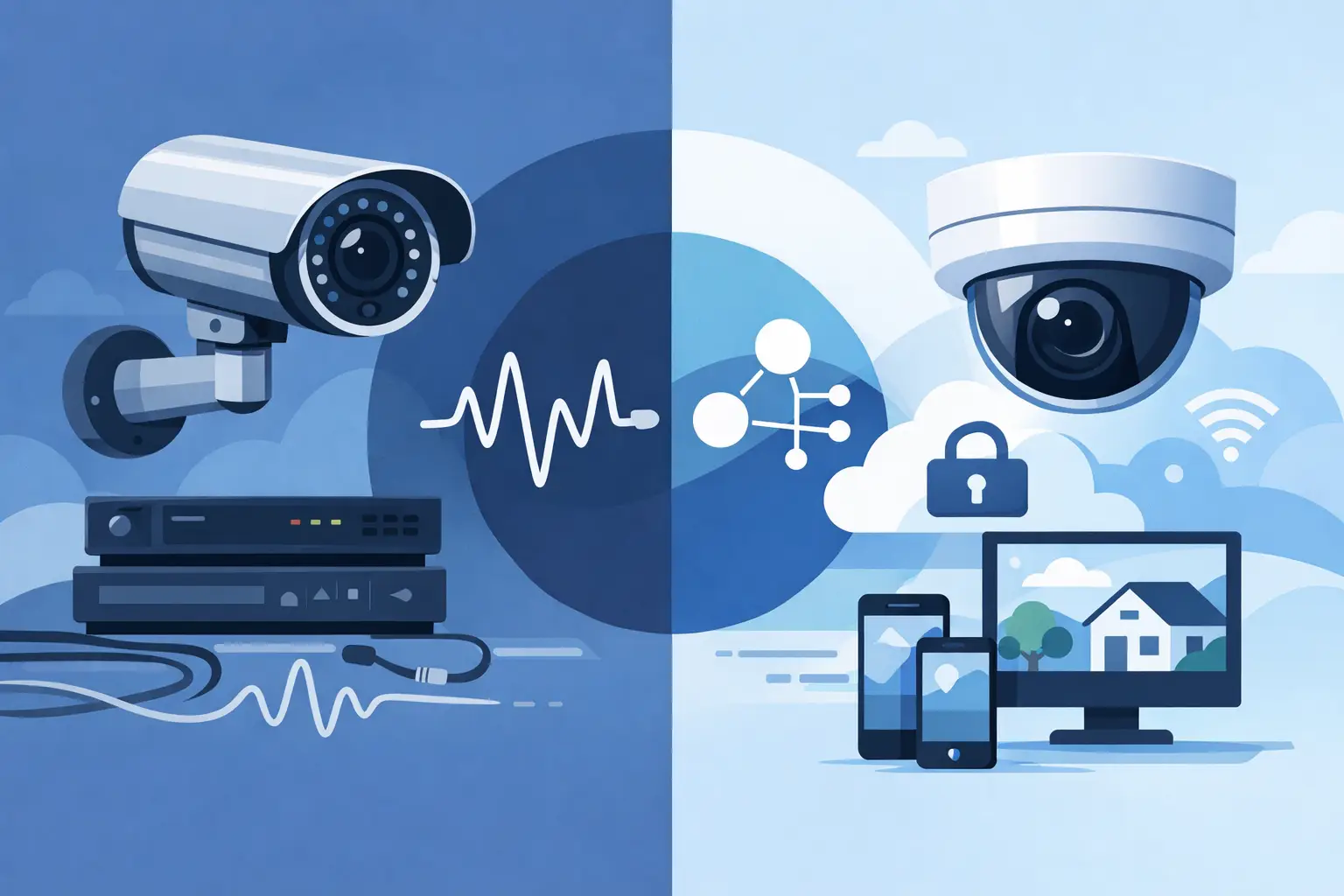

If you're replacing an older camera system or planning a new install, the analog vs IP cameras question usually comes down to one thing: what will work reliably for your property without wasting money. That answer depends on your building, your network, your image quality needs, and how you want to access video day to day.
For some properties, analog still makes sense. For others, IP is the clear long-term choice. The right answer is not the one with the most marketing behind it. It's the one that gives you dependable coverage, usable video, and a system you can live with for years.
Analog vs IP Cameras: The Core Difference
Analog cameras send video to a recorder over coax cable. In modern systems, that usually means HD-over-coax, not the blurry analog footage people remember from older setups. With the right recorder and cameras, analog can still deliver solid high-definition video and dependable performance.
IP cameras work differently. Each camera is a network device that sends digital video over Ethernet cable, typically to a network video recorder. Because the camera itself is processing and transmitting digital video, IP systems offer more flexibility for resolution, remote features, analytics, and system expansion.
That basic difference affects almost everything else - installation, image quality, bandwidth, cost, maintenance, and upgrade options.
Where Analog Cameras Still Make Sense
Analog is often a smart fit when a property already has usable coax wiring in place. If the cable runs are in good condition, upgrading cameras and the recorder can be faster and more affordable than rewiring the building for a full IP system.
This matters in older homes, small businesses, and some commercial buildings where opening walls or ceilings would add unnecessary labor. A modern analog upgrade can improve coverage and clarity without turning the project into a major renovation.
Analog systems also appeal to buyers who want straightforward operation. A dedicated recorder, fixed camera layout, and simple viewing setup can be easier for some users to manage. If the goal is reliable recording at entry points, parking areas, hallways, or cash handling zones, analog may do the job well.
The trade-off is flexibility. Analog can be cost-effective, but it usually offers fewer advanced features than IP, and future growth can be more limited depending on the recorder and existing cabling.
Why IP Cameras Are Often the Better Long-Term Option
IP systems are usually the better fit when image detail matters. If you need to identify faces, read license plates under the right conditions, monitor larger areas, or zoom in on recorded footage without losing as much detail, IP has a clear advantage.
They also fit the way many owners and managers want to use security now. Remote viewing, camera health monitoring, mobile alerts, smart search features, and integration with access control or other network-connected systems are all more natural in an IP environment.
For commercial properties, schools, and multi-building sites, IP also scales better. You can deploy a handful of cameras today and expand later with more flexibility. That does not mean every IP job is simple. It means the system can be designed with growth in mind.
The catch is that IP requires more planning. Network capacity, switch power, cybersecurity, proper addressing, and recorder configuration all matter. A poorly designed IP system can create frustrating problems that have nothing to do with the cameras themselves.
Image Quality Is More Than Resolution
Many buyers focus on megapixels first. Resolution matters, but it is only part of what makes recorded video useful. Lens selection, scene lighting, camera placement, frame rate, night performance, compression settings, and recorder quality all affect what you can actually see.
In the analog vs IP cameras comparison, IP usually wins on maximum image quality and detail. But a well-placed analog HD camera can outperform a badly placed IP camera every day of the week. If the camera is aimed into glare, mounted too high, or covering too wide an area, the added resolution may not solve the real problem.
That is why system design matters as much as hardware. Good surveillance starts with coverage goals, not spec sheets.
Installation and Wiring Differences
Analog installations usually center on coax cable and separate power, unless an existing setup already includes combined cabling. That can be an advantage during upgrades because many buildings already have those pathways in place.
IP cameras typically use Cat5e or Cat6 cable and often receive both data and power through one line using PoE. On a new install, that can make the system cleaner and more efficient. On an existing property, though, the best path depends on what infrastructure is already there.
This is one of the biggest reasons there is no one-size-fits-all answer. A clean new office build may be ideal for IP. An older property with solid coax and limited access above finished ceilings may be a better candidate for analog or a phased migration.
Remote Access, Smart Features, and Everyday Use
Most property owners now expect to check cameras from a phone, tablet, or office computer. Both analog and IP systems can support remote viewing when paired with the right recorder and setup. IP generally offers more options and better integration, but analog is not automatically left behind.
Where IP really separates itself is in advanced features. Depending on the platform, that can include line crossing alerts, intrusion zones, people and vehicle detection, heat mapping, and tighter integration with door access events. These features are useful, but only when configured properly. Too many alerts create noise and cause users to ignore the system.
For a homeowner who wants to see the driveway and front door, those tools may be unnecessary. For a warehouse, school, or commercial entrance with after-hours activity concerns, they can add real value.
Cost: Upfront Price vs Long-Term Value
Analog often looks better on upfront cost, especially when existing coax can stay in service. Hardware can be less expensive, labor may be lower, and the upgrade path can be more direct.
IP can cost more at the beginning because the infrastructure and setup are more involved. Better cameras, network switches, storage planning, and proper programming all add to the project. But long-term value can be stronger if the system needs to expand, integrate with other security tools, or deliver higher-quality evidence.
The real cost question is not just what you spend this month. It is whether the system will still fit your needs three to five years from now.
Analog vs IP Cameras for Different Property Types
For many homes, either platform can work well. If the house has existing wiring and the goal is dependable perimeter coverage, analog may be enough. If the owner wants sharper video, app-based control, and room to add smart features later, IP is often the better investment.
For small and midsize businesses, the decision usually depends on risk points and operational needs. A small storefront may be well served by analog or hybrid options. A business with stock rooms, delivery areas, customer traffic, and liability concerns often benefits from IP's better detail and flexibility.
For schools, municipal sites, and larger facilities, IP is commonly the stronger choice because scale, central management, and future expansion matter more. These environments also tend to need integration with broader security infrastructure.
When a Hybrid Approach Is the Smart Move
Sometimes the best answer is not choosing one side. A hybrid approach can keep parts of a working analog system while introducing IP cameras where better detail or newer features are needed most.
That can be a practical path for phased upgrades. Instead of replacing everything at once, you improve the highest-priority areas first and build toward a more modern system over time. For many budget-conscious properties, that approach makes more sense than forcing a full replacement before it is necessary.
A good installer should be able to look at your current wiring, coverage gaps, and operational goals and tell you whether a partial migration is worth it.
How to Choose the Right System
Start with the problem you are trying to solve. Are you mainly replacing failed equipment? Do you need better night coverage? Do you want remote access from multiple users? Are you trying to identify people clearly, or just monitor activity? Those answers shape the system more than the camera category does.
Next, look at the building itself. Existing wiring, network readiness, mounting conditions, lighting, and recorder location all affect what makes sense. Then consider who will use the system after installation. The best setup is one that performs well and is easy enough for your team or household to use consistently.
At ATECH SECURITY LLC, this is where hands-on field experience matters. Choosing between analog and IP is not about picking a trend. It is about matching the equipment to the property, the risk level, and the way you actually need the system to work.
The best camera system is the one that gives you clear video when it counts, runs reliably every day, and leaves you room to grow without starting over.
Comments